

My Summer with Seaside’s Heermann’s Gulls
This summer, I served as a Community Ambassador Volunteer for the Monterey Audubon Society through CSUMB’s Service Learning program, which gave me an incredible opportunity to support the Heermann’s Gull Outreach project along Seaside’s Broadway Corridor. As someone who grew up in Seaside, I’ve walked along this street countless times, but I had never noticed how deeply intertwined it is with the lives of the gulls that nest on the rooftops above it. Working on this project changed the way I see my hometown and taught me how conservation, community, and civic engagement come together in real time.
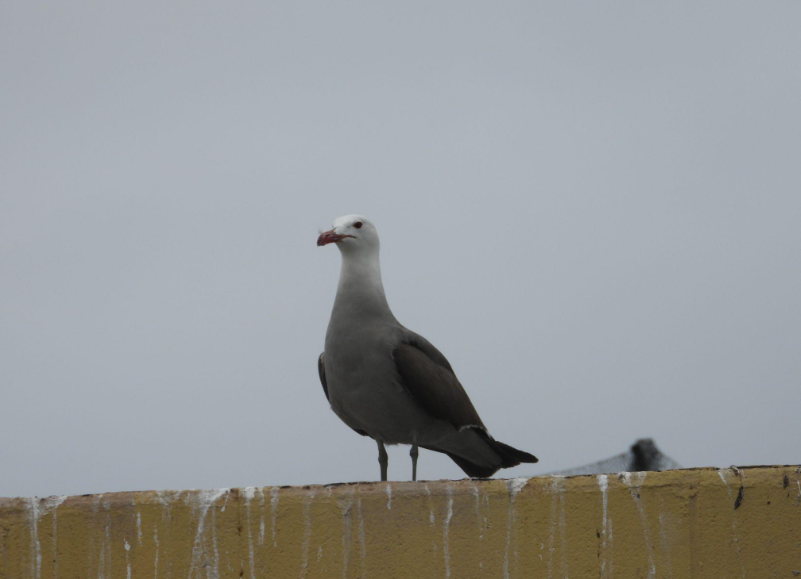
The Heermann’s Gull colony in Seaside is unusual in that it’s one of the only inland nesting sites for this species that has been recorded. This species typically breeds on islands off the coast of Baja California, on Isla Rasa, where nearly 90% of all Heermann’s Gulls (Larus heermanni) nest (Bowen et al. 2015). Talk about putting all of your eggs in one basket! Unfortunately, heavy nearby fishing, the introduction of chick-eating predators like rats, rising ocean temperatures, and rising sea levels pose an existential threat to the colony off Isla Rasa and the survival of the Heermann's Gull.
Though Heermann’s Gulls are regular winter visitors to Monterey Bay, it wasn't until 1999 that an intrepid group decided to stay and nest on two islands in Roberts Lake, a 5-acre lagoon in Seaside, CA. About 20 pairs nested on these islands for nearly a decade, until the islands eroded (Bailey 2009). Their choice to nest on commercial rooftops creates a unique “urban-wildlife interface,” where fledgling chicks often end up on sidewalks, parking lots, and even in the middle of busy streets as they learn to fly. My role was to help bridge the gap between the birds and the people who share this space with them.

From late June through early August, I spoke with nearly one hundred passersby using an informational binder and pamphlets, sharing a safety-first message to explain why volunteers were out on the street. Many people were surprised to learn that the gulls are federally protected once they lay eggs, and that volunteers help herd chicks away from traffic to keep them safe. Some were incredibly supportive and curious; others were frustrated by the messiness of rooftop nesting. But every conversation, supportive or skeptical, helped build awareness and opened space for dialogue.

One of the most meaningful outcomes of our outreach was seeing the city of Seaside install temporary street signs warning drivers to watch for fledgling gulls. These signs slowed traffic and made the area safer for chicks during their vulnerable learning-to-fly period. It was a powerful example of how community partnership can create immediate, practical solutions that benefit both wildlife and residents.
Beyond public outreach, I also observed gull behaviors, contacted SPCA and Seaside Animal Control when injured birds were found, and even swept feathers from sidewalks during molting. These small, hands-on tasks grounded me in the reality of urban conservation work; it's not just about big ideas, but everyday actions that help a community coexist with the wildlife around it.

This project taught me that conservation in a city isn't just a biological challenge; it’s a civic one. It requires communication, patience, and collaboration between residents, businesses, volunteers, and local institutions. I'm grateful for the chance to contribute to this effort and to see firsthand how a community can come together to support a species that has chosen our city as its home.
Saul Aviles Bernal is an Environmental Science Technology & Policy student at CSU Monterey Bay and a Seaside local passionate about urban ecology, conservation, and community‑aligned environmental outreach. All photos are by Saul.
Bowen, T., Velarde, E., Anderson, D. W., & Marlett, S. A. (2015). Federico Craveri and changes in nesting seabirds on Isla Rasa, Gulf of California, since 1856. The Southwestern Naturalist, 60(1), 1-5. https://doi.org/10.1894/MCG-10.1
Bailey, S. F. Nesting of Heermann's Gull: Challenges of an Urban Colonist.


Amazing work, thanks for sharing about these cool gulls! I'll keep a lookout next time I'm on broadway~