

Ending the Heermann’s Gull Season on a High Note

Updated: Aug 16
Standing at the edge of Seaside State Beach, I watched Kyan Russell look through the spotting scope to check the little legs of the gulls. I was thrilled to learn he found a banded fledgling! Wow, a tiny success.

A Rare Colony
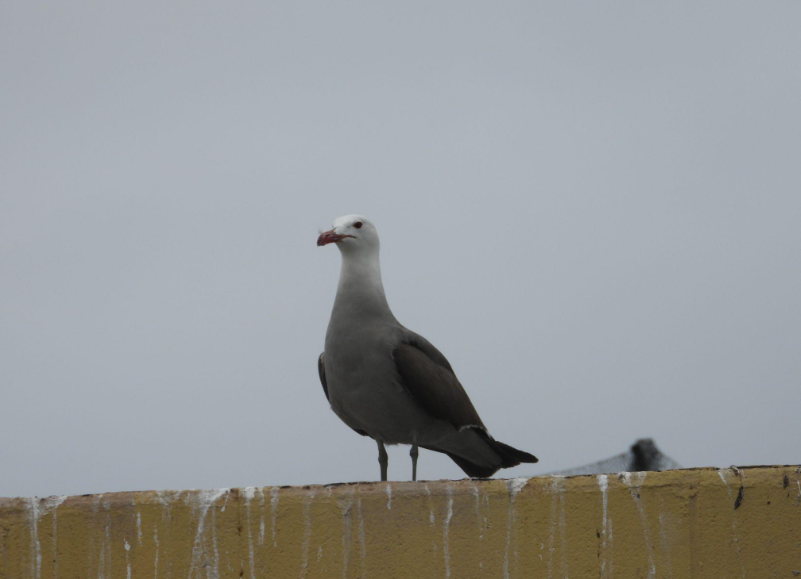
This year’s story starts back in March when Kyan Russell (Heermann’s Gulls project lead and Monterey Audubon Society (MAS) Vice President) led the CSUMB team of interns Aidan and Maxwell to monitor the nests of the Heermann’s Gulls of Seaside, our local celebrity birds. These gulls are not your typical french-fry stealing birds - Seaside hosts the only breeding colony of Heermann’s Gulls in the United States! 90% of the world population breeds on Isla Rasa (a rocky island in Baja California), but this small colony of Near Threatened birds first arrived here in the late 90s. As the monitoring team scoped out the number of nests and locations using a combination of a GoPro-on-a-stick and a drone, we got a better picture of rooftop nesting behavior along Broadway Ave in downtown Seaside.

At the high point of the season, we counted 62 nests, each with 2-3 eggs, which meant that we were in for a busy fledgling season! When the chicks begin to fledge, they overestimate their flying abilities. As they practice flapping, they tend to fall off the rooftops and end up in the street, where they are often killed or injured by cars.
Mobilizing the Ground Forces
Since we only had a couple of weeks before the eggs hatched, we had to work quickly to recruit, train, and deploy our volunteers. Working with Kyan and Amanda Preece (MAS Board Member and Conservation Committee Chair), we developed a virtual training to onboard nearly 20 new volunteers. Once trained, the team went onto the streets of Seaside wearing bright orange vests, equipped with safety flags and outreach materials, including a brand new educational brochure designed by another volunteer. Over 6 weeks, they:
Educated the community by talking with over 200 people about our unique gulls!
Saved lost fledglings: As the fledglings started to tumble off the rooftops, some were stranded on the busy street. The volunteers encouraged them into store alcoves, side streets, and alleys to minimize their risk of being run over.
Cleaned the sidewalks.
Outreach volunteers observe fledglings, talk with passersby, shepherd grounded fledglings to low-traffic areas, and clean the sidewalk.
Community Excitement
Halfway through the season, we held a public contest to design a new logo for this program. We celebrated the winning design with a Pint Night hosted at Other Brother Beer, where over 100 people bought a pint to support MAS. We now have logo merchandise designed by Tessa Wells available to purchase, with part of the proceeds benefiting MAS.
We unveiled the new logo for the project at the Other Brother Beer Pint Night. Along with the logo, we have logo merchandise that people can purchase to support MAS.
Kyan and other outreach volunteers led over 40 people on guided colony tours at that night. They were impressed!

MAS worked with the City of Seaside to post “Slow Baby Birds” signs and install them in
high-traffic areas to raise driver awareness during peak fledgling activity.
And One More Thing…
To learn more about the colony’s movements, we decided to band the fledglings with the supervision of local bird bander Mike Stake. When the outreach volunteers found a stranded bird, we safely captured and tagged it with a metal leg band before returning it to the rooftop from which it fell. It is currently unknown how much movement there is between the Seaside and Baja colonies. We hope that with continued banding, we will be able to better understand where these birds go in the nonbreeding season, and whether the same birds return year after year. Keep an eye out for these birds and report any sightings to USGS!
Banding fledglings and returning them to the rooftop safely.
We celebrated a successful end to the season with a gathering at Seaside State Beach. While there, not only did we count over a dozen fledglings - we saw the very first chick we ever banded: #701! To see that these birds had successfully survived their first few weeks of life in an unforgiving urban environment and made it to the seashore where they will spend the rest of their lives, was nothing short of incredible to witness.

A Huge Win for Conservation
Thank you to every volunteer, partner, and community member who gave their time and care to protect these Near Threatened birds. Last year, Kyan observed 6 chicks die in a single night; this year, we observed less than 10 deaths for the season total! We banded 14 gulls and observed a day high count of 34 fledglings at Seaside State Beach. We also observed 5 different banded individuals at the beach.
What will next year hold? We hope to repeat the success of our inaugural outreach and monitoring program, while also looking for better nesting options. In the long term, a gull colony in a busy urban environment is less than ideal for everyone involved. We are working with the City of Seaside to find a solution that works for locals: avian and human alike.


This article explores the relationship between enclomiphene, hormonal balance, and libido. It explains how changes in hormone levels can be connected with different aspects of well-being. The discussion also recognizes that individual responses can vary. Overall, the article provides a clear introduction to the topic.
https://valhallavitality.com/blog/exploring-the-impact-of-enclomiphene-on-libido-an-in-depth-analysis